

Vehicle owners should choose tire balancing for steering wheel shake at highway speeds and wheel alignment for pulling or uneven tire wear. This guide explains the mechanical differences, diagnostic steps, and specific symptoms to help you identify the correct service for your vehicle.
Wheel Alignment
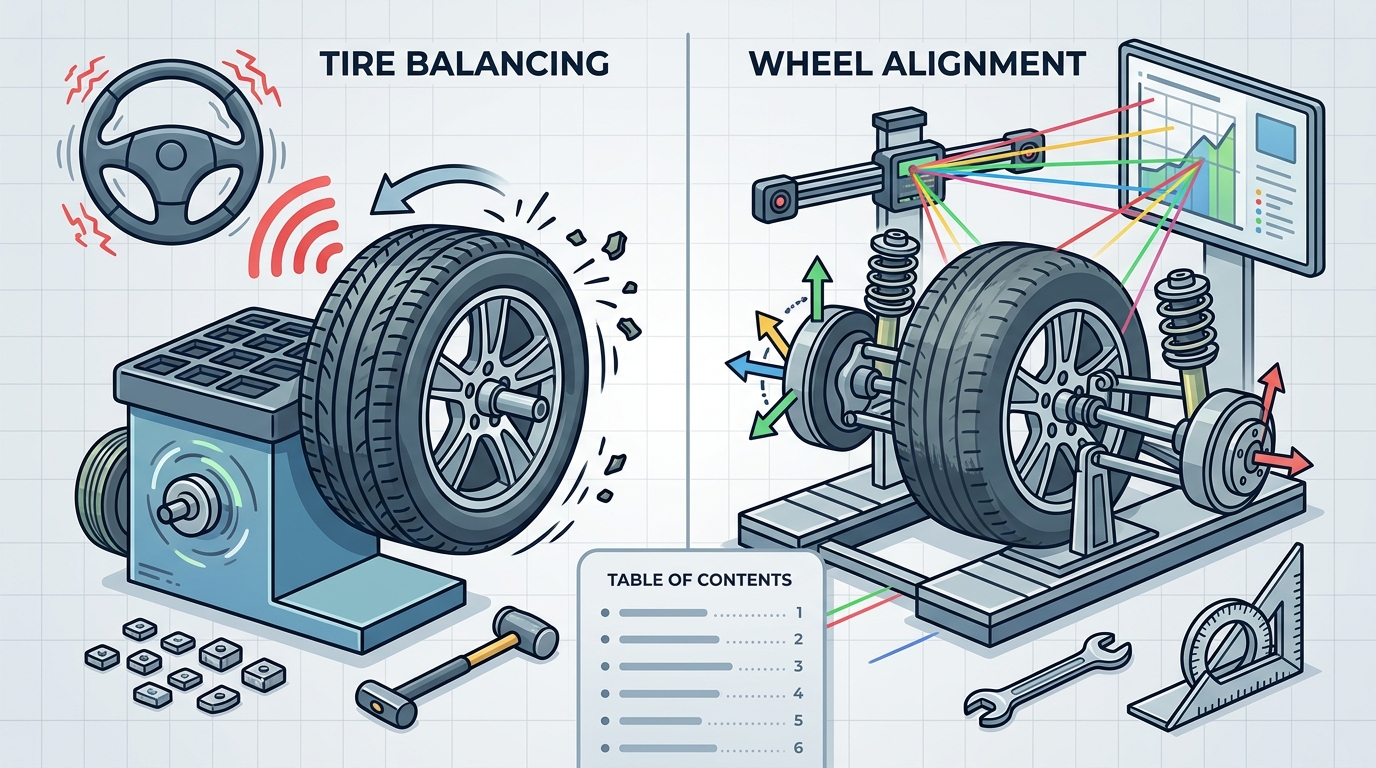
Wheel alignment is the process of adjusting the angles of your vehicle's wheels relative to the chassis and the road surface. This service ensures that tires make proper contact with the pavement, which is critical for maintaining vehicle stability and extending tire life. At Redwood General Tire Pros, we use precision equipment to measure and correct these angles accurately.
Key Alignment Angles
Three primary angles determine your vehicle's alignment: camber, caster, and toe. Camber refers to the inward or outward tilt of the wheel when viewed from the front. Caster affects the steering axis and stability, while toe determines whether the front of the wheels points inward or outward. Incorrect toe settings are the most common cause of uneven tire wear and vehicle pulling.
Impact on Tire Wear
When alignment is off, tires do not roll straight. This causes the inner or outer edges of the tread to wear down faster than the center. Severe misalignment can lead to feathering, where the tread blocks become sharp on one side. Regular alignment checks prevent this premature wear and ensure your vehicle tracks straight on the highway.
Tire Balancing
Tire balancing is the process of adding small weights to the wheel assembly to ensure it rotates evenly. Modern tires and wheels are not perfectly uniform in weight distribution due to manufacturing tolerances. Without balancing, these weight discrepancies create centrifugal forces that cause vibration at specific speeds.
How Balancing Works
Technicians mount the wheel and tire assembly on a spin balancer. The machine measures the weight distribution and calculates where to place adhesive or clip-on weights. This process neutralizes the imbalance, allowing the wheel to rotate smoothly. Proper balancing is essential for maintaining a comfortable ride and protecting suspension components.
Speed-Specific Vibration
Imbalance typically causes vibration that increases with speed. You may notice a shake in the steering wheel between 50 and 70 mph. This is a classic sign of front-wheel imbalance. Rear-wheel imbalance often causes a shake in the seat or floorboard. Addressing this issue promptly prevents damage to wheel bearings and suspension parts.
Diagnostic Differentiation
Distinguishing between alignment and balancing issues requires observing the specific symptoms and performing a physical inspection. While both services address vibration, the root causes and resulting effects differ significantly. A professional diagnosis involves checking tire wear patterns, steering behavior, and vibration characteristics.
Steering Wheel vs. Seat Vibration
The location of the vibration is a primary diagnostic clue. Steering wheel vibration usually indicates a front-wheel balancing issue. Seat or floorboard vibration often points to a rear-wheel imbalance. If the vehicle pulls to one side, alignment is the likely culprit. Understanding these distinctions helps you request the correct service from your technician.
Tire Inspection
Visual inspection of the tires provides additional evidence. Uneven wear across the tread width suggests alignment problems. Worn edges or cupping may indicate suspension issues or severe imbalance. Technicians at Redwood General Tire Pros perform thorough inspections to identify these patterns before recommending a specific service.
Wheel Alignment Symptoms
Recognizing the signs of misalignment helps you address the issue before it causes significant damage. The most common symptom is the vehicle pulling to one side while driving straight. Other indicators include off-center steering, where the wheel is not centered when the car is driving straight, and uneven tire wear.
Pulling and Steering Off-Set
If you must constantly correct the steering wheel to keep the vehicle in your lane, your alignment is likely out of spec. This pulling can be caused by road crown, but persistent pulling on flat surfaces indicates a mechanical issue. Steering off-set occurs when the steering wheel is turned left or right while the vehicle travels straight. This is a clear sign that toe angles need adjustment.
Uneven Tire Wear Patterns
Check your tires for wear that is concentrated on one edge. Inner edge wear often indicates negative camber, while outer edge wear suggests positive camber. Center wear may result from over-inflation, but combined with edge wear, it points to alignment issues. Regular tire inspections help you catch these problems early and save money on premature tire replacements.
Comparison Table: Alignment vs. Balancing
| Feature | Wheel Alignment | Tire Balancing |
|---|---|---|
| Primary Function | Adjusts wheel angles to chassis | Equalizes weight distribution |
| Main Symptom | Pulling to one side | Steering wheel or seat vibration |
| Tire Wear Effect | Uneven edge wear | Minimal if corrected early |
| Speed Sensitivity | Constant pulling | Vibration at specific speeds |
| Service Frequency | Every 6,000-10,000 miles | Every tire rotation or new tire |
Key Takeaways
- Steering wheel vibration at highway speeds usually indicates a tire balancing issue.
- Vehicle pulling to one side is a primary sign of wheel misalignment.
- Uneven tire wear across the tread width suggests alignment problems.
- Seat vibration often points to rear-wheel imbalance rather than alignment.
- Regular alignment checks prevent premature tire wear and extend tire life.
- Proper balancing protects suspension components and wheel bearings.
- Both services are essential for a smooth and safe driving experience.
- Professional diagnosis is the best way to determine the correct service.
Frequently Asked Questions
Can I drive with a wheel alignment issue?
You can drive with a minor alignment issue, but it is not recommended for long periods. Misalignment causes uneven tire wear, which can lead to tire failure. It also affects handling and safety. Schedule an alignment appointment as soon as you notice pulling or off-center steering.
How often should I get my tires balanced?
It is recommended to balance your tires every 6,000 to 7,500 miles, which typically coincides with tire rotations. You should also balance tires immediately after replacing one or more tires. If you notice vibration, have them checked sooner.
Does wheel alignment fix steering wheel vibration?
Wheel alignment does not typically fix steering wheel vibration caused by imbalance. Alignment corrects pulling and uneven wear. If the vibration is speed-dependent and located in the steering wheel, tire balancing is the likely solution. A professional can diagnose the specific cause.
What causes wheel alignment to go out of spec?
Can I do wheel alignment at home?
Wheel alignment requires specialized equipment and expertise that is not typically available to consumers. While you can check for obvious issues, precise adjustment requires professional tools. It is best to have alignment performed by a certified technician to ensure accuracy.
How long does a wheel alignment take?
A standard wheel alignment usually takes 30 to 45 minutes. The exact time depends on the vehicle and the extent of the adjustment needed. Most shops can complete the service during a regular business day without requiring an overnight stay.
Is tire balancing the same as wheel balancing?
Yes, the terms are often used interchangeably. Both refer to the process of ensuring the wheel and tire assembly rotates evenly. The goal is to eliminate vibration caused by weight distribution issues. Technicians use the same equipment and methods for both terms.
Can bad alignment cause tire blowouts?
Severe misalignment can lead to excessive tire wear, which weakens the tire structure. This increases the risk of blowouts, especially at high speeds or under heavy loads. Regular alignment and tire inspections help prevent these dangerous situations.
Conclusion
Choosing between tire balancing and wheel alignment depends on the specific symptoms your vehicle exhibits. Steering wheel vibration at highway speeds typically requires balancing, while pulling and uneven wear indicate alignment issues. Both services are vital for maintaining vehicle safety and tire longevity. For expert diagnosis and service, visit Redwood General Tire Pros in Redwood City, CA. Our ASE-certified technicians are ready to help you get back on the road with confidence.