

High-Speed Vibration: Tire Balancing vs. Wheel Alignment
Vehicle owners experiencing high-speed highway vibrations should typically choose tire balancing first, as it directly addresses weight distribution issues that cause steering wheel shake. Wheel alignment is the correct choice if the vehicle pulls to one side or exhibits uneven tire wear. This guide explains the mechanical differences between these services, how to diagnose the root cause, and when to visit a professional shop like Redwood General Tire Pros in Redwood City.
Wheel Alignment
Wheel alignment is the process of adjusting the angles of your vehicle's wheels relative to the chassis and the road surface. This service ensures that your tires make proper contact with the pavement, which is critical for handling stability and fuel efficiency. The three primary angles adjusted during this process are camber, caster, and toe.
Understanding the Angles
Camber refers to the inward or outward tilt of the wheel when viewed from the front. Caster affects the steering axis and influences how the wheel returns to center after a turn. Toe describes the angle of the wheels when viewed from above, determining whether the tires point slightly inward or outward. Incorrect settings for any of these angles can lead to premature tire wear and a vehicle that feels unstable at high speeds.
Impact on Highway Stability
While alignment issues often manifest as a pulling sensation, they can also contribute to a general sense of instability or wandering on the highway. If the toe settings are off, the tires may scrub against the road surface, generating heat and vibration. At Redwood General Tire Pros, our technicians use precision laser equipment to measure these angles against the manufacturer's specifications. This ensures that your vehicle tracks straight and true, providing a smooth ride even at highway speeds.
Tire Balancing
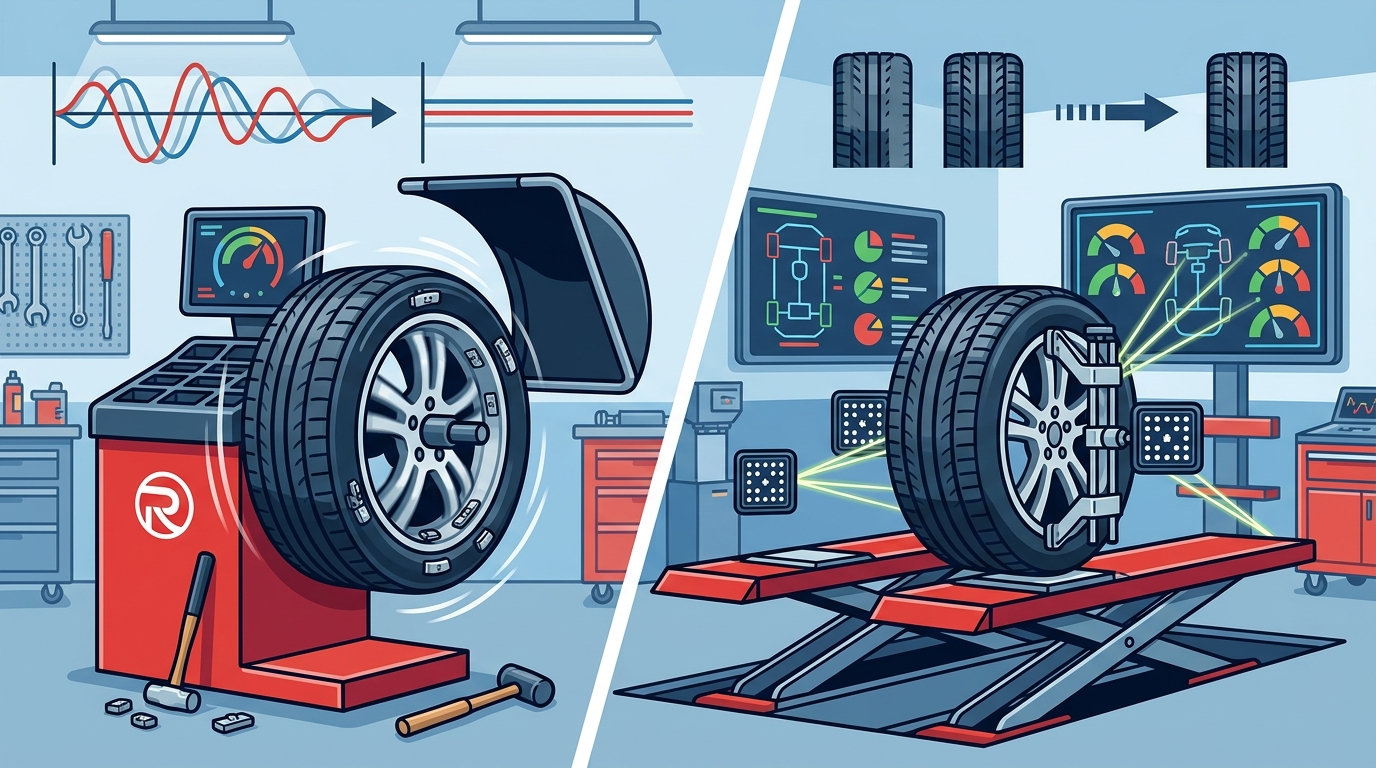
Tire balancing is the procedure of adding small weights to the wheel assembly to ensure that the combined weight of the tire and rim is evenly distributed. When a wheel is not balanced, the heavier side creates a centrifugal force as the wheel spins, resulting in a rhythmic shake. This is the most common cause of steering wheel vibration at speeds between 50 and 70 mph.
How Balancing Works
Technicians mount the wheel and tire assembly on a spin balancer, which rotates the wheel at high speed to detect imbalances. The machine calculates the exact location and amount of weight needed to counteract the heavy spot. Weights are then attached to the rim, either on the inside or outside, depending on the wheel design. This process is quick and non-invasive, often completed in under an hour for a set of four tires.
Why Balance Matters for High Speeds
The effects of an unbalanced wheel are negligible at low speeds but become pronounced as velocity increases. A small imbalance that is barely noticeable at 30 mph can cause significant vibration at 70 mph. This vibration can travel through the suspension and into the steering column, making the steering wheel shake. Regular balancing, typically recommended every 5,000 to 7,500 miles, helps maintain ride comfort and extends the life of your suspension components.
Diagnostic Differentiation
Distinguishing between a need for balancing and a need for alignment requires observing specific symptoms and understanding the mechanics of each system. While both services improve ride quality, they address different mechanical faults. A proper diagnosis prevents unnecessary spending and ensures the correct fix is applied.
Speed and Location of Vibration
The speed at which the vibration occurs and where it is felt are key diagnostic indicators. Steering wheel vibration that increases with speed is a classic sign of front-wheel imbalance. Vibration felt in the seat or floorboard, particularly at higher speeds, may indicate rear-wheel imbalance or a bent wheel. If the vehicle pulls to one side or the steering wheel is off-center when driving straight, alignment is the likely culprit.
Visual Inspection of Tires
Examining the tire tread provides valuable clues. Uneven wear across the tread, such as excessive wear on the inner or outer edges, points to a camber or toe alignment issue. Cupping or scalloping, where the tread has a wavy pattern, is often a sign of suspension problems or severe imbalance. At Redwood General Tire Pros, our ASE-certified technicians perform a thorough visual inspection to identify these wear patterns before recommending a specific service.
Comparison of Services
| Feature | Tire Balancing | Wheel Alignment |
|---|---|---|
| Primary Goal | Even weight distribution | Correct wheel angles |
| Common Symptom | Steering wheel shake | Vehicle pulling to one side |
| Tire Wear Pattern | Minimal if balanced | Uneven edge wear |
| Frequency | Every 5,000-7,500 miles | Every 6,000-10,000 miles |
| Equipment Used | Spin balancer | Laser alignment rig |
Wheel Alignment Symptoms
Recognizing the signs of a misaligned vehicle allows owners to address the issue before it causes significant damage. While some symptoms are subtle, others are immediate and noticeable. Being aware of these indicators helps in making an informed decision when scheduling service.
Steering Wheel Position
If the steering wheel is not centered when driving straight on a flat road, this is a clear sign of a toe alignment issue. You may find yourself constantly making small corrections to keep the vehicle in its lane. This constant correction can lead to driver fatigue and reduced safety on long highway drives.
Vehicle Pulling
A vehicle that consistently pulls to the left or right, even on a straight, level road, indicates an alignment problem. This pulling can be caused by road crown, but if it persists on different roads, it is likely due to incorrect wheel angles. Ignoring this symptom can lead to uneven tire wear and reduced handling precision.
Uneven Tire Wear
Inspecting your tires for uneven wear is one of the most reliable ways to diagnose alignment issues. Excessive wear on the inner or outer edges of the tires suggests a camber problem. Wear on the center of the tread may indicate over-inflation, while wear on both edges suggests under-inflation. However, if the wear is consistent on one side of the vehicle, alignment is the probable cause.
Key Takeaways
- Steering wheel vibration at high speeds is most commonly caused by tire imbalance.
- Vehicle pulling to one side is the primary indicator of a wheel alignment issue.
- Tire balancing involves adding weights to the rim to ensure even weight distribution.
- Wheel alignment adjusts the camber, caster, and toe angles to manufacturer specifications.
- Uneven tire wear patterns can help differentiate between alignment and suspension issues.
- Regular maintenance of both balancing and alignment extends tire life and improves safety.
- Professional diagnosis is recommended to accurately identify the root cause of vibrations.
Frequently Asked Questions
What is the main difference between tire balancing and wheel alignment?
Tire balancing ensures the weight of the tire and wheel is evenly distributed to prevent vibration. Wheel alignment adjusts the angles of the wheels to ensure they are perpendicular to the ground and parallel to each other.
Can a bad alignment cause steering wheel vibration?
Yes, although it is less common than imbalance. Severe alignment issues can cause the tires to scrub against the road, leading to vibration and uneven wear.
How often should I get my tires balanced?
It is generally recommended to balance your tires every 5,000 to 7,500 miles, or whenever you rotate your tires.
How often should I get a wheel alignment?
A wheel alignment should be checked every 6,000 to 10,000 miles, or immediately after hitting a large pothole or curb.
Can I drive with an unbalanced tire?
While it is possible to drive with an unbalanced tire, it is not recommended. Prolonged driving with unbalanced tires can cause premature tire wear and damage to suspension components.
Where can I get these services in Redwood City?
Redwood General Tire Pros offers both tire balancing and wheel alignment services in Redwood City, CA. Our ASE-certified technicians use advanced equipment to ensure precise results.