

Tire Balancing vs Wheel Alignment: Fixing High-Speed Highway Vibrations
Vehicle owners should choose tire balancing for steering wheel shakes at high speeds and wheel alignment for vehicle pulling or uneven tire wear. This guide explains the mechanical differences between these two critical services, how to diagnose the root cause of highway vibrations, and when to visit a professional shop like Redwood General Tire Pros for a comprehensive inspection.
Tire Balancing: The High-Speed Stabilizer
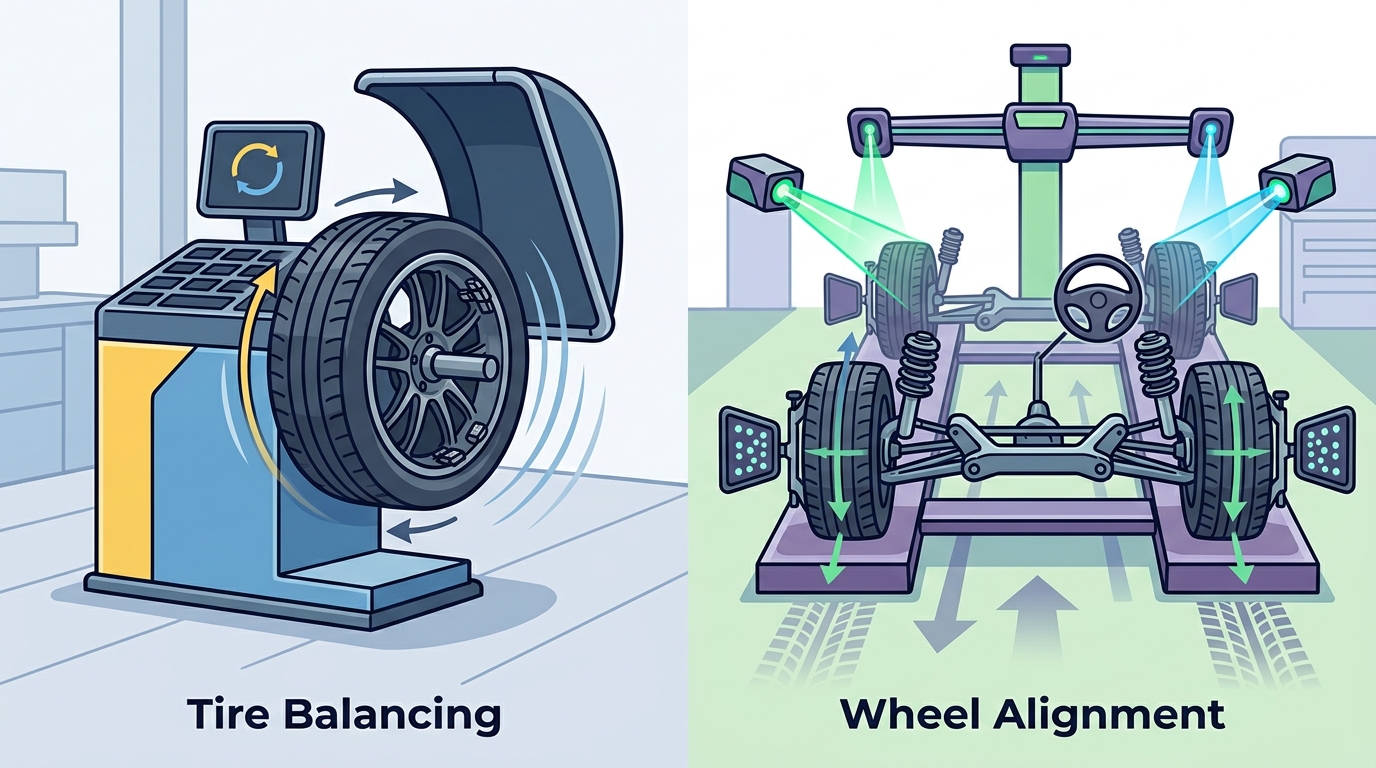
Tire balancing is the process of adding small weights to the wheel assembly to ensure the mass is distributed evenly around the axle. When a wheel is perfectly balanced, it rotates smoothly without creating centrifugal forces that translate into vibration. Most modern vehicles are sensitive to weight imbalances exceeding a few grams, which is why even a small pebble stuck in a tread groove or a missing factory weight can cause noticeable shaking.
Why High-Speed Vibration Occurs
The physics of rotation mean that imbalance issues are often invisible at low speeds but become severe at highway velocities. As the wheel spins faster, the centrifugal force generated by an uneven mass distribution increases exponentially. This is why a driver might feel a smooth ride in city traffic but experience a significant shake in the steering wheel at 60 to 70 mph. The vibration typically originates from the front wheels, as they are directly connected to the steering column.
Signs of Imbalance
Drivers can identify imbalance through specific sensory cues. The most common symptom is a vibration felt in the steering wheel that intensifies with speed. If the vibration is felt in the seat or floorboard rather than the wheel, the issue may be with the rear wheels. Additionally, a humming or droning noise that changes pitch with speed can indicate a wheel that is out of balance or has a bent rim.
Wheel Alignment: The Geometry Corrector
Wheel alignment is the adjustment of the angles of the wheels relative to the vehicle's chassis and the road surface. Proper alignment ensures that all four tires make optimal contact with the pavement, which is essential for straight-line tracking and even tread wear. Unlike balancing, which deals with mass distribution, alignment deals with the geometric orientation of the wheel assembly.
The Three Key Angles
Technicians adjust three primary angles during an alignment: camber, caster, and toe. Camber is the inward or outward tilt of the wheel when viewed from the front. Caster is the angle of the steering axis when viewed from the side, which affects steering stability. Toe is the angle of the wheels when viewed from above, determining whether the tires point slightly inward or outward. Incorrect toe settings are the most common cause of a vehicle pulling to one side.
Impact on Tire Wear
While imbalance causes vibration, misalignment causes premature tire wear. A vehicle with a significant toe-out condition will scrub the tires against the road surface, leading to feathering or cupping of the tread. This not only reduces the lifespan of the tires but can also affect handling stability. If a driver notices that their vehicle drifts to the left or right when the steering wheel is centered, an alignment is required rather than a balance.
Diagnostic Differentiation: Identifying the Root Cause
Correctly diagnosing the source of a vibration is the first step toward a permanent fix. Many drivers assume that any shake requires a new set of tires, but this is rarely the case. By observing the vehicle's behavior, owners can narrow down whether the issue is mechanical (balancing) or geometric (alignment).
Steering Wheel vs. Seat Vibration
The location of the vibration is the primary diagnostic tool. If the shake is isolated to the steering wheel, the front wheels are likely out of balance. If the vibration is felt in the seat or the floor of the vehicle, the rear wheels are the probable culprit. If the entire vehicle shakes, including the steering wheel and the seat, the issue may be more complex, potentially involving worn suspension components or a bent wheel.
Speed-Specific Symptoms
The speed at which the vibration occurs provides further clues. Vibration that appears at 55 to 65 mph and worsens as speed increases is a classic sign of wheel imbalance. Vibration that is present at all speeds, or that is accompanied by a pulling sensation, suggests an alignment issue or a tire defect. If the vibration only occurs when braking, the issue is likely related to the brake rotors rather than the wheels or alignment.
Visual Inspection
A visual check of the tires can reveal obvious problems. Look for uneven wear patterns, such as excessive wear on the inner or outer edges of the tread. Check for visible damage to the wheel rim, such as bends or cracks, which can cause imbalance that cannot be fixed with weights alone. If the tires are worn unevenly, an alignment should be performed before new tires are installed to ensure the new set lasts as long as possible.
Service Comparison and Cost Implications
Understanding the differences between these two services helps vehicle owners make informed decisions about maintenance. The table below summarizes the key distinctions between tire balancing and wheel alignment.
| Feature | Tire Balancing | Wheel Alignment |
|---|---|---|
| Primary Purpose | Even mass distribution | Correct wheel angles |
| Primary Symptom | Steering wheel vibration at high speed | Vehicle pulling to one side |
| Effect on Tires | Prevents vibration-related stress | Prevents uneven tread wear |
| Frequency | Every tire rotation or new tire install | Every 6,000 to 10,000 miles or after impact |
| Equipment Used | Dynamic balancer | Alignment rack and sensors |
Both services are essential for maintaining vehicle safety and performance. Neglecting either can lead to increased repair costs and reduced tire life. For vehicle owners in the Redwood City area, professional wheel alignment services are available to ensure your vehicle tracks straight and true.
Key Takeaways
- Tire balancing fixes steering wheel vibrations at high speeds by equalizing wheel mass.
- Wheel alignment corrects vehicle pulling and prevents uneven tire wear by adjusting wheel angles.
- Vibration in the steering wheel usually indicates a front wheel imbalance.
- Vibration in the seat or floorboard usually indicates a rear wheel imbalance.
- Vehicle pulling to one side is a sign of misalignment, not imbalance.
- Both services should be performed when new tires are installed.
- Regular maintenance of both systems extends tire life and improves fuel efficiency.
- Professional diagnosis is recommended if symptoms are unclear or persist after service.
Frequently Asked Questions
Can I drive with a wheel vibration?
While a minor vibration may not cause immediate damage, driving with a significant imbalance can stress suspension components and lead to premature tire wear. It is recommended to have the vehicle inspected as soon as possible to prevent further issues.
How often should I get my wheels balanced?
It is generally recommended to balance your wheels every 5,000 to 7,500 miles, or whenever you rotate your tires. If you notice a vibration, you should have them balanced immediately regardless of mileage.
How often should I get my wheels aligned?
Most manufacturers recommend an alignment check every 6,000 to 10,000 miles. You should also get an alignment after hitting a large pothole, curb, or if you notice your vehicle pulling to one side.
Does balancing fix a pulling sensation?
No, balancing does not fix a pulling sensation. Pulling is a geometric issue caused by misalignment or brake drag. If your vehicle pulls, you need a wheel alignment, not a balance.
Can a bent wheel cause vibration?
Yes, a bent wheel rim can cause a vibration that cannot be fixed with balancing weights. If the rim is bent, it must be repaired or replaced to eliminate the vibration.
Do I need both balancing and alignment when buying new tires?
Yes, it is best practice to have both services performed when installing new tires. This ensures the new tires are mounted on balanced wheels and that the vehicle's geometry is correct, maximizing the lifespan of the new investment.
Where can I get these services in Redwood City?
Redwood General Tire Pros offers comprehensive wheel services, including wheel balancing and alignment, to ensure your vehicle runs smoothly and safely.
Conclusion
Choosing between tire balancing and wheel alignment depends on the specific symptoms your vehicle exhibits. Balancing is the solution for high-speed steering wheel shakes, while alignment is the fix for vehicle pulling and uneven tire wear. By understanding the distinct roles of these two services, vehicle owners can make informed decisions that protect their investment and ensure a safe driving experience. For expert service and diagnosis, trust the team at Redwood General Tire Pros to keep your vehicle in top condition.