

Passenger vehicle tires should generally be rotated every 5,000 to 7,500 miles to prevent uneven tread wear and extend overall tire life. This guide covers the specific mileage intervals, manufacturer recommendations, and the physical mechanics of tire wear. We will also explore how driving conditions in the Bay Area impact these schedules and how to identify when your tires need professional attention.
Tire Rotation Intervals
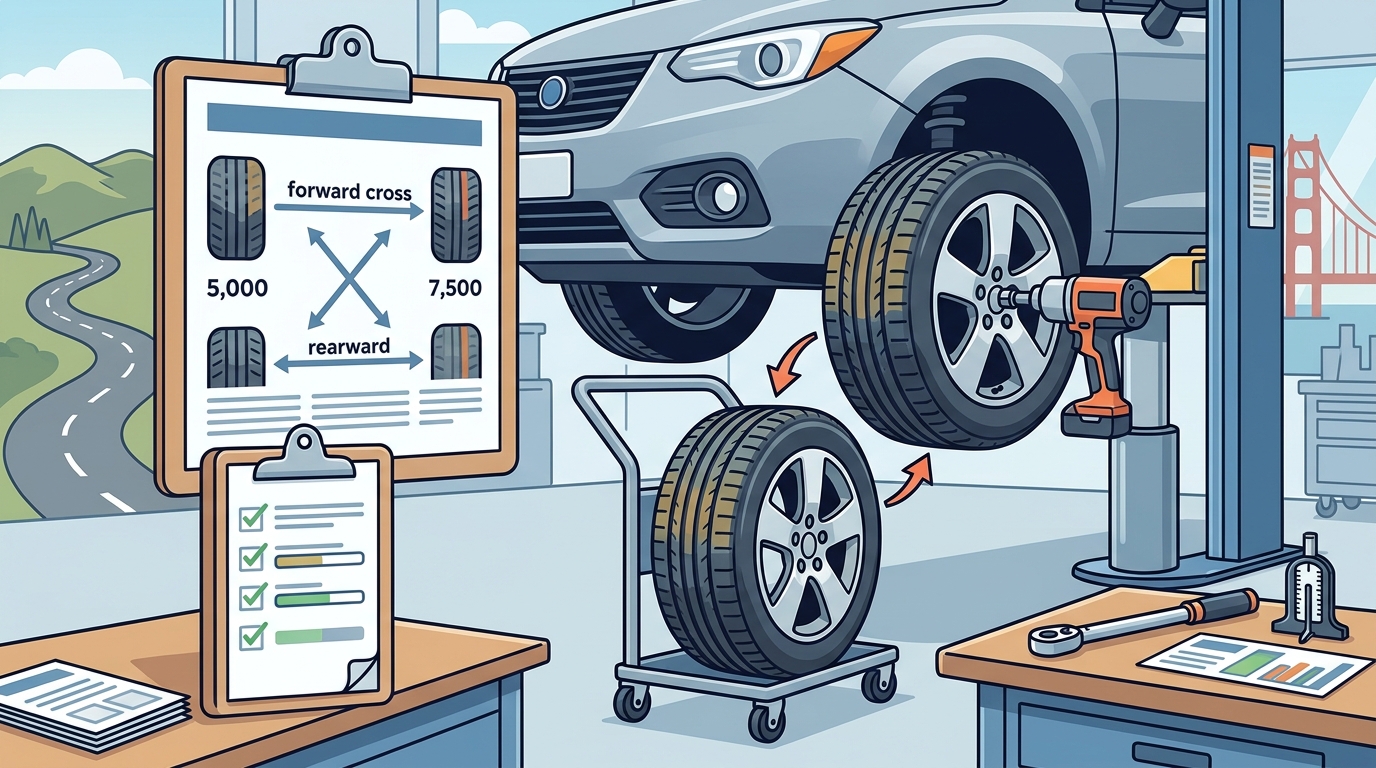
The standard interval for rotating passenger vehicle tires is every 5,000 to 7,500 miles. This range aligns with the frequency of most routine maintenance services, such as oil changes. By combining these tasks, drivers can maintain a consistent schedule without needing to remember multiple different dates or mileage markers. For most modern vehicles, the 7,500-mile mark serves as a reliable benchmark for ensuring that all four tires wear at a similar rate.
Why Mileage Matters More Than Time
While some drivers think of rotation in terms of months, mileage is the more accurate metric. Tires wear down based on the friction and pressure applied to the rubber, not the passage of time. A vehicle that sits in a garage for six months may not need a rotation if it has only accumulated 1,000 miles. Conversely, a vehicle used for daily commuting in heavy traffic may reach the 5,000-mile threshold in just three months. Focusing on mileage ensures that the rotation happens exactly when the wear differential between the front and rear tires begins to become significant.
The Role of Preventive Maintenance
Regular rotation is a form of preventive maintenance that protects your investment in new tires. When tires are rotated, the wear is distributed evenly across all four wheels. This prevents any single tire from reaching the minimum tread depth limit before the others. At Redwood General Tire Pros, we emphasize that consistent rotation is the single most effective way to maximize the lifespan of your tires. It is a low-cost service that yields a high return on investment by delaying the need for a full set of replacements.
Manufacturer Recommendations
Vehicle manufacturers provide specific guidance on tire rotation intervals within the owner's manual. These recommendations are based on the specific drivetrain configuration of the vehicle, including whether it is front-wheel drive, rear-wheel drive, or all-wheel drive. While the general 5,000 to 7,500-mile rule applies to most cars, some manufacturers may specify a different interval based on the type of tires installed at the factory. It is essential to consult the manual for your specific make and model to ensure you are following the guidelines that protect your vehicle's warranty and performance.
Drivetrain Specifics
The drivetrain of a vehicle dictates how weight and power are distributed, which directly impacts tire wear. Front-wheel drive vehicles typically experience faster wear on the front tires because they handle both steering and propulsion. Rear-wheel drive vehicles often see more wear on the rear tires due to the transfer of power. All-wheel drive systems distribute power to all four wheels, which can result in more even wear but still requires regular rotation to maintain balance. Understanding your vehicle's drivetrain helps in understanding why the manufacturer recommends a specific rotation pattern.
Consulting the Owner's Manual
The owner's manual is the primary source of truth for maintenance schedules. It will specify the exact mileage interval and the recommended rotation pattern. Some manuals may also include warnings about the consequences of skipping rotations, such as voiding the tire warranty. We recommend that drivers keep their manual in the vehicle or have a digital copy accessible on their phone. If you are unsure about the specific recommendation for your car, our team at Redwood General Tire Pros can review your manual and provide a tailored maintenance plan.
The Mechanics of Uneven Tread Wear
Cupping and Feathering
Cupping is a wear pattern where small depressions or "cups" form in the tread. It is often caused by worn suspension components, such as shocks or struts. Feathering, on the other hand, looks like a sawtooth pattern in the tread grooves and is usually a sign of improper wheel alignment. While rotation does not fix these underlying mechanical issues, it helps to distribute the wear so that no single tire is compromised. If you notice these patterns, it is important to have your suspension and alignment checked in addition to rotating your tires.
Shoulder Wear and Center Wear
Shoulder wear occurs when the outer edges of the tire wear down faster than the center. This is often a result of under-inflation. Center wear, where the middle of the tread wears down faster, is typically caused by over-inflation. Both of these patterns can be exacerbated by uneven wear across the four tires. Regular rotation allows a technician to inspect the tires for these specific patterns and address the root cause, such as adjusting tire pressure or repairing suspension parts. This proactive approach ensures that your tires remain safe and efficient.
Driving Conditions and Environmental Factors
Driving conditions play a significant role in how quickly tires wear. In the Bay Area, drivers often navigate a mix of highway speeds, stop-and-go traffic, and varied road surfaces. These conditions can accelerate wear on certain parts of the tire. For example, frequent hard braking in city traffic can wear down the front tires more quickly. Similarly, driving on rough or unpaved roads can cause more aggressive wear on the tire shoulders. Adjusting your rotation interval based on your typical driving environment can help you stay ahead of potential issues.
Highway vs. City Driving
Highway driving tends to produce more even wear because the tires are rotating at a consistent speed. City driving, with its frequent starts and stops, places more stress on the tires. If your daily commute involves a lot of city driving, you may want to lean toward the shorter end of the rotation interval, such as every 5,000 miles. This ensures that the wear is distributed before it becomes problematic. Our technicians at Redwood General Tire Pros can assess your driving habits and recommend the optimal interval for your specific situation.
Climate and Road Surface
The climate in Redwood City and the surrounding areas can also impact tire wear. While the region is known for its mild weather, the roads can vary from smooth asphalt to older, more textured surfaces. These variations can affect how the tire tread interacts with the road. Additionally, the use of winter tires or all-season tires can influence the rotation schedule. If you switch between different sets of tires, it is important to rotate each set according to its own schedule. This ensures that all tires, regardless of the season, are in good condition when they are put back on the vehicle.
Common Rotation Patterns
There are several standard patterns used for rotating tires, each suited to different vehicle configurations. The most common patterns are the cross rotation, the straight rotation, and the forward rotation. The choice of pattern depends on the type of tires installed and the drivetrain of the vehicle. Using the correct pattern ensures that the tires wear evenly and that the directional or asymmetric tread designs are maintained.
Cross Rotation
Cross rotation is the most common pattern for vehicles with non-directional tires. In this pattern, the front tires move to the rear on the opposite side, and the rear tires move to the front on the opposite side. This pattern helps to even out the wear caused by steering and propulsion. It is suitable for most front-wheel drive and rear-wheel drive vehicles. At Redwood General Tire Pros, we use the appropriate rotation pattern based on your vehicle's specifications to ensure optimal results.
Straight and Forward Rotation
Straight rotation involves moving the front tires straight to the rear and the rear tires straight to the front. This pattern is often used for vehicles with directional tires, which are designed to rotate in a specific direction. Forward rotation is a variation where the front tires move to the rear on the same side, and the rear tires move to the front on the same side. This pattern is less common but may be recommended for certain all-wheel drive vehicles. The key is to follow the manufacturer's recommendation for the specific pattern to be used.
Key Takeaways
- Rotate your tires every 5,000 to 7,500 miles to prevent uneven tread wear.
- Always consult your vehicle's owner's manual for the manufacturer's specific recommendation.
- Uneven wear patterns like cupping and feathering indicate underlying mechanical issues.
- Driving conditions, such as city traffic and road surface, can affect how often you need to rotate.
- Use the correct rotation pattern for your vehicle's drivetrain and tire type.
- Regular rotation extends the life of your tires and improves vehicle safety.
- Combine tire rotation with other maintenance services like oil changes for convenience.
- Professional inspection can help identify and address the root causes of uneven wear.
Frequently Asked Questions
How often should I rotate my tires if I drive mostly on the highway?
If you drive mostly on the highway, you can typically rotate your tires every 7,500 miles. Highway driving tends to produce more even wear, so the longer interval is usually sufficient. However, it is still important to monitor your tires for any signs of uneven wear.
Does tire rotation affect my fuel efficiency?
Yes, tire rotation can affect your fuel efficiency. Unevenly worn tires can increase rolling resistance, which reduces fuel efficiency. By keeping your tires evenly worn, you can help maintain optimal fuel economy.
Can I rotate my tires myself?
While it is possible to rotate your tires yourself, it requires the proper tools and knowledge. It is recommended to have a professional perform the rotation to ensure it is done correctly and to inspect for any other issues.
What is the difference between tire rotation and wheel alignment?
Tire rotation involves moving the tires to different positions on the vehicle to even out wear. Wheel alignment involves adjusting the angles of the wheels to ensure they are perpendicular to the ground and parallel to each other. Both are important for maintaining tire health.
How do I know if my tires need to be rotated?
The best way to know is to check your mileage. If you have reached the 5,000 to 7,500-mile interval, it is time to rotate your tires. You can also look for signs of uneven wear, such as cupping or feathering.
Does tire rotation void my tire warranty?
No, tire rotation does not void your tire warranty. In fact, many tire warranties require regular rotation to remain valid. Failing to rotate your tires as recommended could potentially void the warranty.
What is the best tire rotation pattern for an all-wheel drive vehicle?
The best pattern for an all-wheel drive vehicle depends on the specific manufacturer's recommendation. Some all-wheel drive vehicles use a cross rotation, while others use a straight rotation. Always consult your owner's manual for the correct pattern.
How much does tire rotation cost?
The cost of tire rotation varies by shop. At Redwood General Tire Pros, we offer competitive pricing for our tire services. We recommend checking our current offers for the best deals.
Conclusion
Regular tire rotation is a simple yet essential part of vehicle maintenance. By following the recommended intervals and patterns, you can prevent uneven tread wear and extend the life of your tires. At Redwood General Tire Pros, we are committed to helping you keep your vehicle in top condition. Our ASE-certified technicians provide expert tire services and maintenance to ensure your safety and satisfaction. Schedule your next tire rotation today and drive with confidence.